It is 7:40 on a weekday morning in a Business Bay car park. You turn the key, hear a single click, and nothing else happens. The meeting you were driving to is in an hour, the sun is already strong, and a neighbor is offering jumper cables.
That is exactly when safety matters most, because a rushed jump start is when mistakes happen. This guide covers what to check first, the correct cable order, and when to stop and call for help. If you would rather not take the risk, a professional jump start service in Dubai can reach most areas in 15 to 30 minutes, day or night.
Park safely first, then check the battery
Park the donor car close enough for the cables to reach, but make sure the two cars do not touch. Put both cars in Park or neutral, apply the handbrakes, switch both engines off, and turn on your hazard lights. On a busy road, move to a safer spot if you can do so without pushing the car into traffic.
Then look at the battery before you touch it. Do not jump-start a battery that is swollen, cracked, leaking, very hot, or giving off a strong rotten-egg smell. Those are stop signals. A battery in that condition should be replaced, not jumped, because it can vent gas and, in rare cases, burst. Never lean directly over a battery while connecting cables, and wear eye protection if you have it.
Keep flames, cigarettes, and sparks away from the battery area, and keep loose tools and cables clear of fans, belts, and hot engine parts. If you cannot see the terminals clearly, check your owner’s manual first. On modern cars the battery may be in the boot or under a seat, with designated jump points under the bonnet.
The Correct Cable Order, Step by Step
Cable order protects both cars.
- Turn everything off in both cars: lights, air conditioning, radio, and phone chargers.
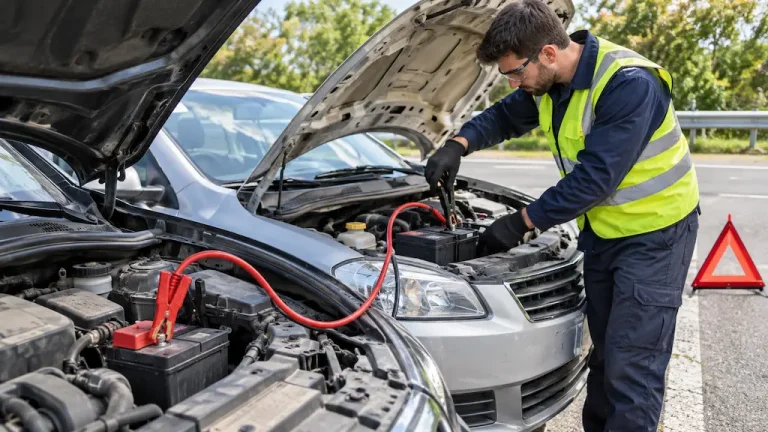
- Connect the red clamp to the positive (+) terminal of the dead battery.
- Connect the other red clamp to the positive (+) terminal of the donor battery.
- Connect the black clamp to the negative (-) terminal of the donor battery.
- Connect the final black clamp to a clean, unpainted metal point on the dead car’s engine block or chassis, away from the battery. Never connect it to the negative terminal of the dead battery.
- Start the donor car and let it run for two to three minutes.
- Try to start the dead car. Crank for no more than about 20 seconds at a time, then wait two minutes before trying again.
- Once the dead car is running, switch the donor car off before you remove any clamp.
- Remove the clamps in exact reverse order: engine-block ground first, then donor negative, donor positive, and finally the dead car’s positive.
The final black clamp goes on bare metal because completing the circuit can spark, and a charging lead-acid battery can vent hydrogen gas. Putting that spark away from the battery vents keeps it away from the gas. Switching the donor off before disconnecting also avoids a voltage spike when the circuit is broken while an alternator is charging.
Dubai heat, sand, and underground car parks
First, heat. Sustained summer heat speeds up fluid loss and wear, which is why batteries here often fail earlier than the life printed on the label. Work in the shade where possible, and do not leave metal tools lying across the battery.
Second, sand and corrosion. Dust can build up around terminals, and heavy corrosion can weaken the connection enough to cause arcing. If the terminals are heavily corroded, have them cleaned and inspected before jumping.
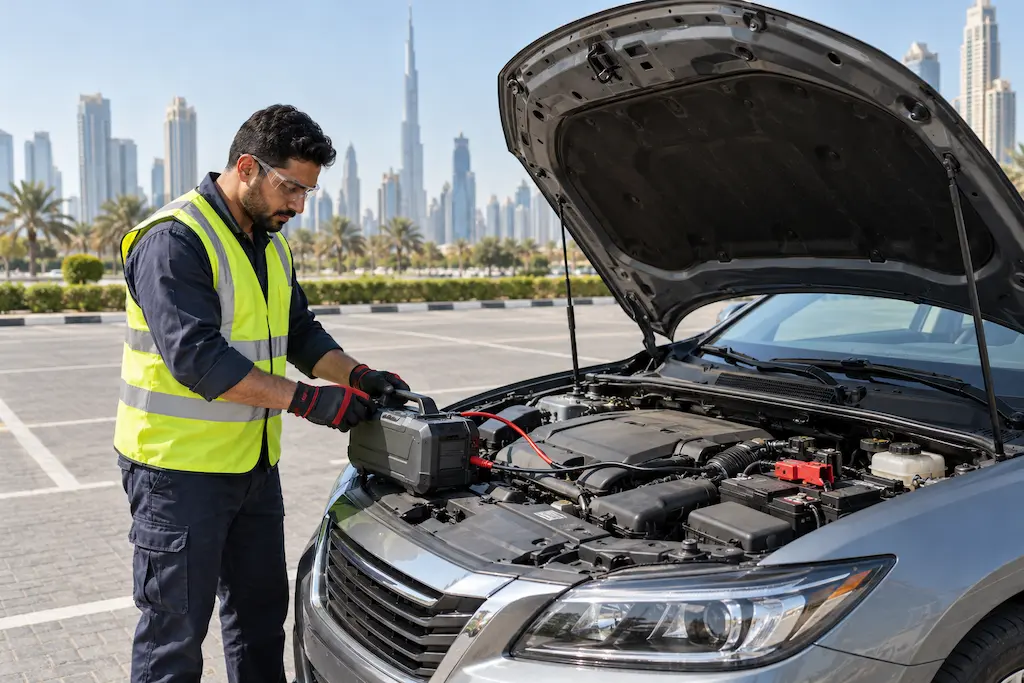
Third, underground car parks. These are common in Dubai, yet there may be no room for a donor car bonnet-to-bonnet and ventilation is poor. In a tight bay, a portable jump starter is often safer, because it needs no second car and no long cable run across a walkway.
Hybrids, EVs, and Automatic Cars Need Extra Care
Do not treat every car the same. On a hybrid or electric vehicle, only jump the 12-volt auxiliary system if your owner’s manual clearly allows it, and never touch orange high-voltage cables. If you are unsure, call a professional rather than guessing.
You also cannot push-start an automatic. Unlike a manual, it has no clutch to spin the engine from the wheels, so rolling it will not help. A jump start, a portable starter, or a tow are the practical options. For the automatic-specific steps, see how to start an automatic car with a dead battery.
Portable Jump Starters: A Safer Option For Many Drivers
A portable jump starter removes the need for a donor car, which helps in basement car parks, on busy roads, and late at night. Follow the pack’s own manual, as the switch-on and clamp order can differ by model. In general, connect red to positive and black to a grounded metal point, switch the pack on only when the clamps are secure, start the car, then switch it off and remove the clamps in reverse order. Keep it charged, and store it somewhere cooler than a sun-baked boot.
After the Jump: Drive, Do Not Just Idle
A jump start does not recharge your battery. It only borrows enough current to turn the engine over; the alternator must then refill it while also running the car.
Drive for at least 30 minutes, and drive rather than idle. At idle, much of what the alternator produces is used by the car itself, especially with air conditioning running in Dubai heat. Ease back optional loads where you safely can, such as phone charging, but keep headlights on at night and enough air conditioning to stay alert.
If the car dies again soon after, or needs a jump again the next morning, that is a warning, not a one-off. It may mean the battery can no longer hold a charge, something is draining it overnight, or the alternator is not charging properly.
Common Mistakes That Cause Damage
- Reversing polarity, which can damage electronics in seconds.
- Letting the red and black clamps touch each other while connected.
- Connecting the final black clamp to the dead battery’s negative terminal.
- Disconnecting clamps while the donor engine is still running.
- Cranking repeatedly without a pause, which overheats the starter motor.
- Jumping a swollen, cracked, leaking, or rotten-egg-smelling battery.
- Switching off after a five-minute drive, assuming the problem is fixed.
If the car does not start after two careful attempts, stop. Repeated attempts will not fix a battery that cannot hold charge or an alternator fault.
When to Call a Professional Instead
Call for help if the battery shows any stop signal above, if you cannot identify the terminals or jump points, if the car is a hybrid or EV and you are unsure, if you are in a dangerous roadside position, or if the jump fails twice. A professional should also test the battery and charging system after a successful jump.
Quick Jump Start covers all of Dubai, runs 24 hours a day, reaches most areas in 15 to 30 minutes, and states its service starts from AED 120, with the price confirmed before dispatch.
Frequently Asked Question
1. Is it safe to jump-start a car yourself in Dubai?
Yes, if the battery is undamaged, you follow the cable order above, and you stop at any warning sign. If you are unsure about terminals, vehicle type, or roadside safety, a professional is safer.
2. Can a car battery explode during a jump start?
It is rare, but a lead-acid battery can burst if hydrogen gas ignites, which is why clamp order, ventilation, and not jumping a damaged battery matter.
3. How long should I drive after a jump start in Dubai?
At least 30 minutes of driving, not idling, and longer if the battery was deeply flat or you were in slow traffic with air conditioning running.
4. Should the donor car stay running while I disconnect the cables?
No. The donor should be running while you crank the dead car, but switch it off before you remove any clamp. Disconnecting while an alternator is charging can cause a voltage spike that damages electronics.
5. What if the car still will not start after two jump attempts?
Stop and do not keep cranking. Two failures usually point to a battery that cannot hold charge, an alternator fault, or a connection problem. Get the battery and charging system tested.
Conclusion
Safe jump-starting in Dubai comes down to a short checklist: park safely, inspect the battery, use the correct clamp order, finish on bare metal, switch the donor off before disconnecting, and then drive long enough to recharge. Skip the jump if the battery is damaged, and get it tested if the problem repeats. If you are stranded and would rather not risk it, Quick Jump Start is available around the clock across Dubai, with a battery health check after the jump.