Few things ruin a morning like turning the key and getting nothing back but a click. In Dubai, it tends to happen at the worst moments: a mall car park in July, a tower basement at 11 pm, a driveway after a long weekend away. The good news is that a flat battery is one of the easier car problems to deal with, as long as you go about it the right way.
This guide covers how to jump start a car safely, how to tell whether the battery is really the problem, and what to do if the engine still won’t start. And if you would rather not handle cables and clamps yourself, a jump start service in Dubai can take care of it for you.
One thing before we start. The order you connect the cables matters more than anything else in this guide. Get that right, and most of the risk goes away.
What a Jump Start Actually Does
A jump start borrows power from another battery (in a second car or a portable jump pack) so your engine can turn over. That’s all it does. It doesn’t recharge your battery in any meaningful way. The alternator does that while you drive.
So think of a jump start as a way to get moving, not a repair. If the battery is old or damaged, it will let you down again, usually at the next bad moment. That’s why a good battery jump start service tests the battery after the jump instead of just clamping on and leaving.
Is It Really the Battery? Signs to Check First
Before you reach for the cables, spend a minute working out what you’re dealing with. A jump start only helps if the battery is the problem.
Signs it’s the battery
- The engine cranks slowly, like it’s struggling
- You hear rapid clicking when you turn the key
- Headlights and dashboard lights are dim or flicker
- The car sat overnight (or for a few days) and now won’t start
- The radio, AC, or screen cuts out while you try to start
Signs it might be something else
- The engine cranks normally but never fires. The battery is doing its job. Look at fuel or ignition instead.
- One loud click, with bright lights. That points to the starter or its connection, not a flat battery.
- Nothing at all, no lights, no click. It could be a badly corroded or loose terminal, a blown main fuse, or a battery that has failed completely.
- The car starts, then dies a few minutes later. This usually means the alternator isn’t charging, so the battery drains as you drive.
- Battery warning light on while driving. Same story: the charging system needs attention.
- Push-button start won’t respond: Sometimes it’s just a weak battery in the key fob, not the car battery.
A simple check: switch on your headlights, then try to start the car. If the lights stay bright and don’t dip, the battery probably isn’t your issue. If they fade or go out as you turn the key, the battery is the likely culprit.
What You Need Before You Start
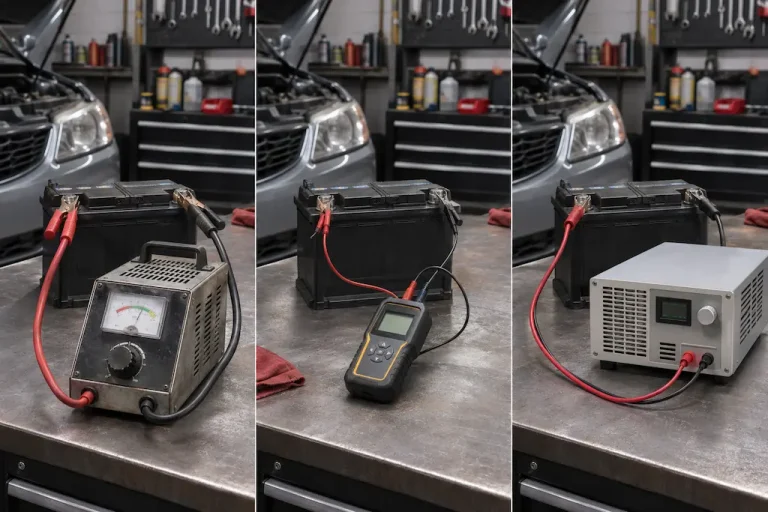
- A set of thick, undamaged jumper cables with solid clamps, or a portable jump starter
- A second car with a healthy 12V battery (if you’re using cables)
- Your owner’s manual
- Gloves and eye protection, if you have them
Cheap, thin, or frayed cables are a common reason jump starts fail. If the cables get warm or the clamps feel loose, don’t trust them.
Safety Checks Before You Connect Anything
Car batteries give off hydrogen gas, which is flammable. And that is just the beginning of it. There is no harm in familiarizing yourself with safety tips on jump-starting your car. The essential things to know are:
- Read the manual, Some cars have dedicated jump points under the bonnet, and some keep the battery in the boot or under a seat.
- Switch everything off on both cars: engines, lights, AC, radio. Put both in Park (or neutral) with the handbrake on.
- Keep the cars apart, Close enough for the cables to reach, but not touching.
- Look at the battery, If it’s cracked, swollen, leaking, or smells like rotten eggs, don’t jump it. It needs replacing.
- Check that both batteries are 12V, Almost all passenger cars are, but it’s worth confirming.
- No smoking, no flames, no loose jewellery dangling near the battery.
- Wipe off dust or white crust on the terminals if you can do it safely. Fine desert dust and corrosion build up on terminals here and can stop the clamps making good contact.
How to Jump Start a Car Safely: Step by Step
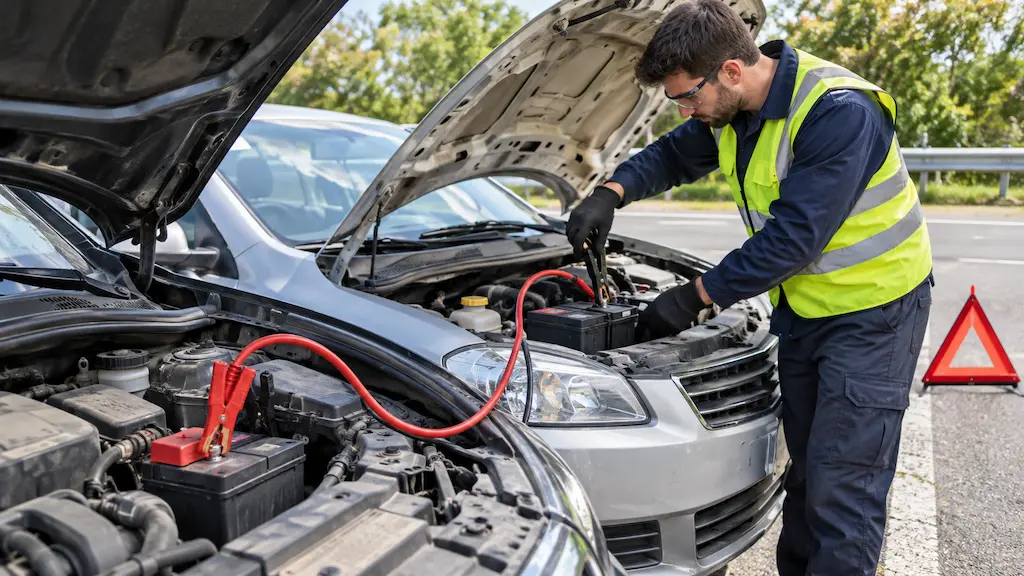
Here’s the sequence for a standard jump start with cables. It won’t take you long to memorize every step on how to jump-start your car in Dubai. To start, we’ll call the flat car the “dead car” and the one helping it the “donor car”.
- Park the donor car close to the dead car, nose to nose or side by side, whichever lets the cables reach without stretching. Turn both engines off.
- Open both bonnets and find the batteries. The positive terminal has a plus sign and often a red cover. The negative has a minus sign.
- Connect one red clamp to the positive terminal of the dead battery.
- Connect the other red clamp to the positive terminal of the donor battery.
- Connect one black clamp to the negative terminal of the donor battery.
- Connect the last black clamp to a bare, unpainted metal part of the dead car, such as a metal bracket or the engine block, away from the battery, fuel lines, and moving parts. Don’t put it on the dead battery’s negative terminal. This is the step people get wrong most often, and it’s the one that keeps a spark away from the battery.
- Start the donor car and let it run for a few minutes. This gives the dead battery a bit of charge before you ask it to do any work.
- Try to start the dead car, Crank in short bursts of a few seconds. If it doesn’t catch, wait a couple of minutes with the donor running and try again.
- Once it’s running, remove the cables in reverse order, black clamp off the metal point, black off the donor, red off the donor, red off the dead car. Don’t let the clamps touch each other or any metal while the other end is still connected.
- Leave the engine running. Don’t switch it off the moment you’re back on your feet.
After the Jump: What to Do Next
The jump gets you going, but the battery is still low. Here’s how to deal with what comes next:
- Drive for a decent stretch, roughly 20 to 30 minutes, rather than a quick trip to the shops. Short drives don’t give the alternator enough time to recharge the battery.
- Don’t turn the engine off until you’ve reached somewhere you’re happy to be stuck, because it may not restart.
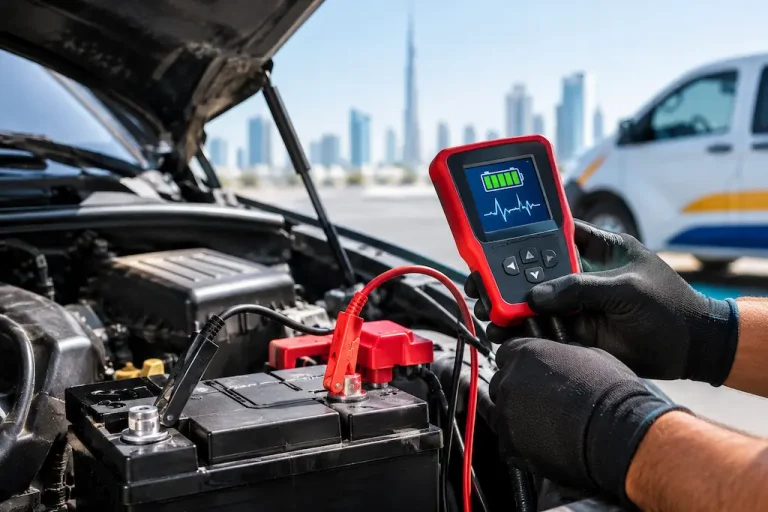
- Get the battery tested soon. A battery that went flat for no obvious reason (no lights left on, no long sit) is usually telling you something.
- Think about its age, If you need a jump start in Dubai, the heat is usually part of the story: batteries here often start to fade after two to three years.
If the battery fails the test, it’s often easier to replace the battery on the spot than to arrange a second trip.
Special Cases: Modern Cars, Hybrids and Tight Spaces
Start-stop and luxury cars
Cars with start-stop systems often use AGM or EFB batteries, and many European models keep the battery in the boot or under a seat, with separate jump terminals under the bonnet.
Connecting to the wrong point can damage electronics that are expensive to fix. Our technicians are used to finding the right connection on everything from a Toyota to a Mercedes-Benz or a BMW, but if you’re doing it yourself, the manual is your best friend.
Hybrids and electric cars
These still have a 12V battery that runs the car’s systems, and that’s the one that goes flat. Many have designated jump points, and some manufacturers have specific instructions or advise against using a hybrid or EV as the donor. Check the manual before connecting anything.
Underground car parks
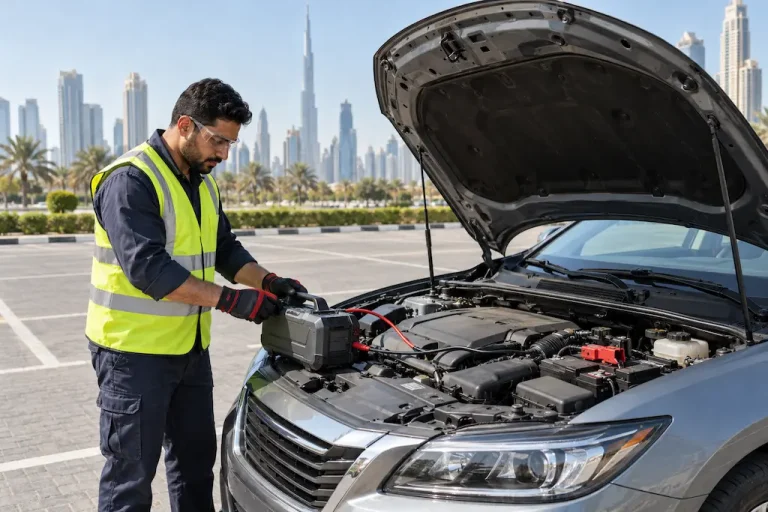
In a tight basement bay, getting two cars close enough is often impossible. A portable jump starter is the more practical option here, since it doesn’t need a second car.
Automatic cars
Don’t try to push-start an automatic. It won’t work, and you risk damaging the car (and yourself).
What If the Car Still Won’t Start?
If you’ve followed the steps and the engine stays silent, don’t keep cranking. Run through this short list:
- Check the clamps: Wiggle each one. A loose or dirty connection is the most common cause of a failed jump.
- Give it more time: Leave the donor running for another five to ten minutes, then try again.
- Inspect the cables: Thin or damaged ones can’t carry enough current.
- Listen to the car: If it cranks but doesn’t fire, the battery isn’t the issue. If it clicks and the lights go dim, the battery may be too far gone to take a jump.
- Stop after a couple of tries: Repeated cranking can overheat the starter and drain whatever the donor has given you.
- Walk away if something’s wrong: Swelling, leaking, a hot battery or a strong smell means stop and keep clear.
At that point it’s a job for someone with a proper tester and the right equipment.
When It’s Time to Call a Professional
Doing it yourself makes sense on a straightforward car, with decent cables and a calm location. Call for help if:
- You don’t have a donor car or a jump pack
- The battery looks damaged or smells
- The car is a hybrid, EV, or high-end model with unusual jump points
- You’re in an underground car park or somewhere cars can’t get close
- The car has needed a jump more than once recently
- It’s late, you’re tired, and you’d simply rather not risk it
A mistake with the cables can cost far more than a call-out. If you do end up searching for a car jump start near me, look for a provider that confirms the price first and tests the battery afterwards.
Although it varies as to how much a car jump start service costs in Dubai, typical emergency jump start services that run 24/7 tend to start from anywhere around AED 120. However, it is recommended that the price is confirmed before a technician is sent,
Conclusion
Jump starting a car safely comes down to a few things: checking that the battery really is the problem, inspecting it before you connect anything, following the right cable order, and driving long enough afterwards for the battery to recover. Most failed attempts trace back to loose clamps, damaged cables or a battery that has simply reached the end of its life.
If you’d rather leave it to a professional jump start car service, contact us and we’ll get a technician to you.
Frequently Asked Questions
Can jump starting damage my car?
It can, if the cables are connected in the wrong order or to the wrong points. Modern cars have sensitive electronics, so check the manual and follow the sequence carefully.
How do I know if it’s the battery or the alternator?
If the car starts after a jump but dies again soon after, the alternator is the likely cause. A battery problem usually shows up as slow cranking or clicking before you get it running.
Can I jump start a car without another car?
Yes. A portable jump starter works on its own, which is handy in car parks where a second vehicle can’t get close. Follow its instructions, as the connection steps can differ slightly.
How long should I drive after a jump start?
Around 20 to 30 minutes is a sensible target, ideally at a steady speed rather than stop-start traffic, so the alternator has time to put some charge back.