A car battery can show 12.7 volts and still fail to start an engine. That might sound contradictory, but it highlights an important distinction in battery diagnostics: having enough charge does not necessarily mean having a healthy battery.
For drivers searching for a reliable jump start service in Dubai, understanding this difference can help explain why a vehicle starts after receiving assistance but develops the same problem again a few days later.
Two measurements are particularly useful when assessing automotive battery condition: State of Charge (SOC) and State of Health (SOH). One describes the energy currently available, while the other indicates how much of the battery’s original performance remains.
Let’s examine how both measurements work, how they are tested and what their results mean for everyday driving.
1. State of Charge (SOC): How Much Energy Is Available?
State of Charge represents the amount of electrical charge currently stored in a battery relative to its available capacity. It is normally expressed as a percentage.
Think of SOC as a fuel gauge. It tells you how much energy is available, but says very little about the condition of the system holding it.
For example:
- 100% SOC: The battery is fully charged.
- 75% SOC: Approximately three-quarters of its available charge remains.
- 50% SOC: The battery is partially discharged.
- 25% SOC: The available charge is considerably reduced.
A low SOC reading can result from leaving headlights switched on, extended parking, repeated short journeys or a charging-system problem.
The battery itself may still be perfectly serviceable. Recharging it correctly could restore normal operation without requiring replacement.
2. State of Health (SOH): How Much Performance Remains?
State of Health measures a battery’s present condition against its original specifications.
Every rechargeable battery experiences gradual deterioration. Over time, internal chemical changes reduce its ability to store energy and deliver the current required to start an engine.
SOH assessment considers several performance indicators:
- Remaining usable capacity.
- Cold cranking capability.
- Internal resistance or conductance.
- Evidence of internal deterioration.
Unlike SOC, SOH does not simply improve because a battery has been charged.
A battery may reach full charge but still struggle to provide sufficient starting current. This is particularly relevant to older batteries that have experienced repeated discharge cycles or prolonged exposure to high temperatures.
3. SOC vs SOH: Understanding the Technical Difference
Although these measurements are closely related, they answer two different diagnostic questions.
| Parameter | State of Charge (SOC) | State of Health (SOH) |
|---|---|---|
| What it measures | Current charge level | Overall battery condition |
| Main concern | Available energy | Remaining performance |
| Typical measurement | Voltage-based estimation and battery monitoring | Diagnostic testing and performance estimation |
| Changes over time | With charging and discharging | Gradually with battery ageing |
| Low reading indicates | Insufficient charge | Possible deterioration |
| Does charging improve it? | Usually, if the battery is serviceable | Does not reverse internal ageing |
Consider a battery with reduced capacity because of ageing. It might display a full charge relative to its remaining capacity, yet deliver considerably less starting power than when it was new.
This is why checking voltage alone can produce an incomplete diagnosis.
4. Why Can a Fully Charged Battery Still Fail?
A healthy battery must do more than store electrical energy. It must also deliver sufficient current when the starter motor demands it.
Starting an engine requires a substantial burst of electrical power. If internal resistance increases or the battery’s available capacity deteriorates, its voltage may drop significantly under load.
Drivers may notice:
- Slower engine cranking.
- Clicking sounds during ignition.
- Dashboard lights dimming when starting.
- Repeated starting failures.
- Problems returning shortly after jump-starting.
These symptoms can also indicate alternator faults, poor electrical connections or excessive parasitic drain. Battery condition should therefore be assessed alongside the vehicle’s charging and starting systems.A weak battery is not the only possible cause of starting trouble. Read our guide on how to distinguish a battery problem from an alternator fault before deciding which component needs attention.
5. How Are SOC and SOH Measured?
Battery technicians use different testing methods because neither measurement can be established reliably through appearance alone.
Measuring State of Charge
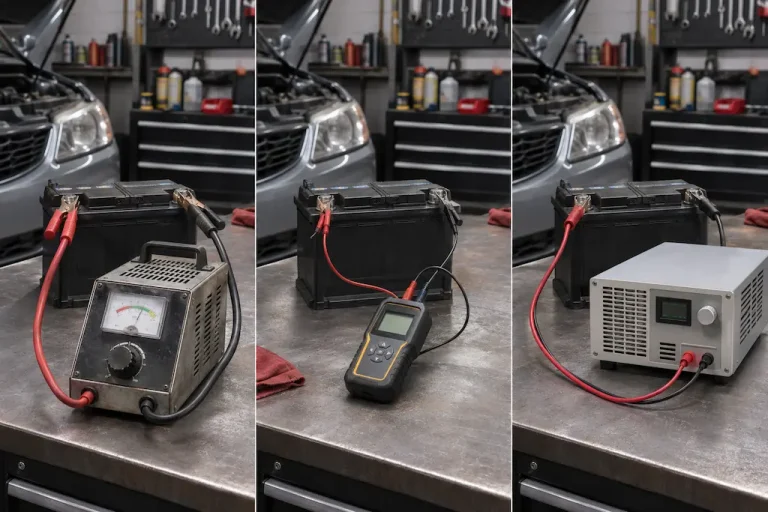
A multimeter can provide an approximate SOC indication through resting battery voltage.
For a conventional 12V lead-acid battery:
| Resting Voltage | Approximate Charge |
|---|---|
| 12.7–12.8V | Nearly full |
| 12.4V | Around 75% |
| 12.2V | Around 50% |
| 12.0V | Around 25% |
| Below 11.9V | Very low |
These readings are approximate and assume the battery has rested without recent charging or significant electrical load. Battery chemistry and temperature can influence the results.
Measuring State of Health
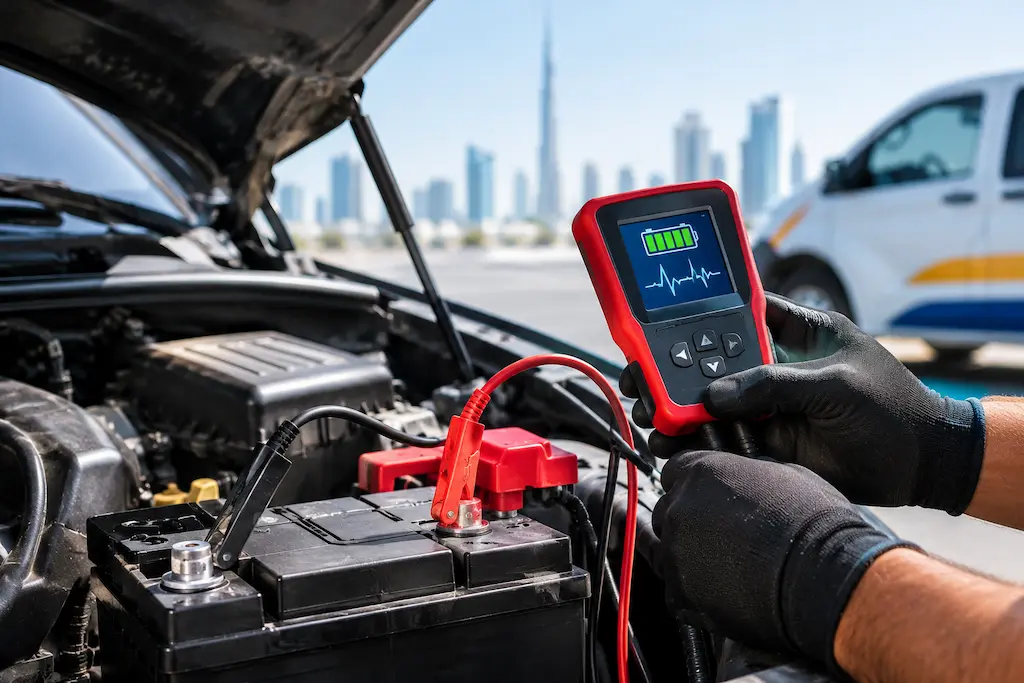
A professional battery tester can estimate SOH using measurements such as:
Cold Cranking Amps (CCA): Assesses the battery’s starting-current capability against its rated specification.
Conductance testing: Evaluates electrical conductance to estimate battery performance and internal condition.
Load testing: Measures how the battery responds when subjected to an electrical load.
The results help distinguish a discharged battery from one that has deteriorated and may need replacement.
6. How Dubai’s Driving Conditions Affect Battery Condition
Battery performance is influenced by more than age. The environment and driving pattern also matter.
Dubai presents several conditions that can contribute to battery deterioration:
- High temperatures: Accelerate internal chemical ageing and can shorten battery service life.
- Extended parking: Allows natural discharge and can expose existing weaknesses.
- Frequent short journeys: May not provide sufficient charging time to replace the energy used during starting.
- Heavy electrical consumption: Air conditioning, lighting and electronic equipment place additional demands on the vehicle’s electrical system.
A battery that repeatedly becomes discharged should not automatically be replaced. First establish whether the underlying problem is insufficient charging, excessive electrical consumption or declining battery health.
7. When Is a Jump Start Enough, and When Is Replacement Necessary?
A jump start provides temporary electrical assistance to get an engine running. It does not restore lost battery capacity or repair internal deterioration.
The distinction matters when deciding what to do next.
| Battery Condition | Appropriate Action |
|---|---|
| Healthy battery with low SOC | Recharge and investigate why it discharged |
| Low SOC caused by prolonged parking | Recharge and retest |
| Poor SOH with weak starting performance | Consider battery replacement |
| Repeated discharge with healthy battery | Investigate alternator and electrical drain |
| Damaged or leaking battery | Professional assessment and appropriate replacement |
For recurring starting problems, a battery assessment should follow rather than relying on repeated jump starts
Conclusion
SOC and SOH describe two different aspects of battery performance. A battery can have plenty of charge but insufficient starting capability, just as a healthy battery can become discharged after prolonged parking.
For accurate diagnosis, both measurements should be considered alongside the alternator, electrical connections and starting system.
If your vehicle repeatedly needs a jump start, identifying the underlying fault is more useful than simply getting the engine running again. Quick Jump Start provides 24/7 roadside jump-start assistance and mobile battery replacement across Dubai.
Frequently Asked Questions
Can a car battery have 100% SOC but low SOH?
Yes. An ageing battery can be fully charged relative to its reduced remaining capacity but still lack sufficient power to start the engine reliably.
Does a jump start increase battery SOH?
No. A jump start supplies temporary electrical assistance. It cannot reverse internal battery deterioration or restore lost capacity.
Can a multimeter measure battery health?
A multimeter measures voltage, which helps estimate SOC under suitable conditions. It cannot independently establish SOH. A suitable battery tester is needed for further assessment.
What causes low battery state of charge?
Common causes include prolonged parking, electrical accessories remaining switched on, frequent short journeys, alternator problems and excessive parasitic drain.
When should I replace my car battery?
Replacement may be necessary when testing identifies poor starting performance, reduced capacity or internal deterioration that cannot be resolved through appropriate charging.