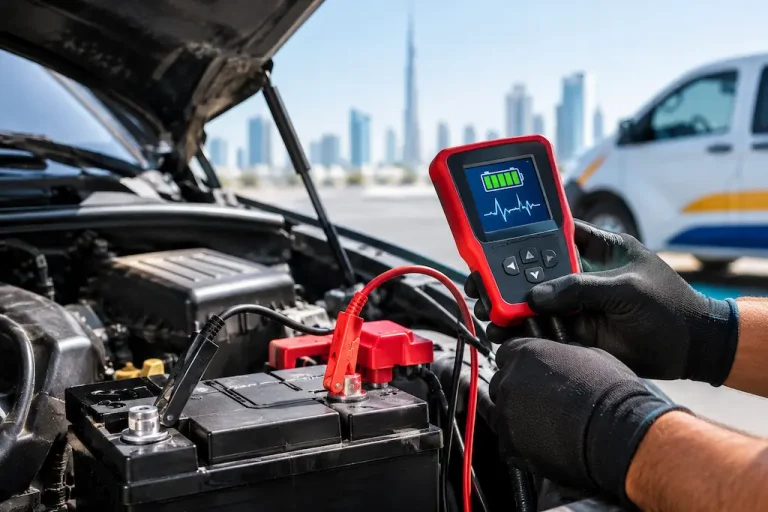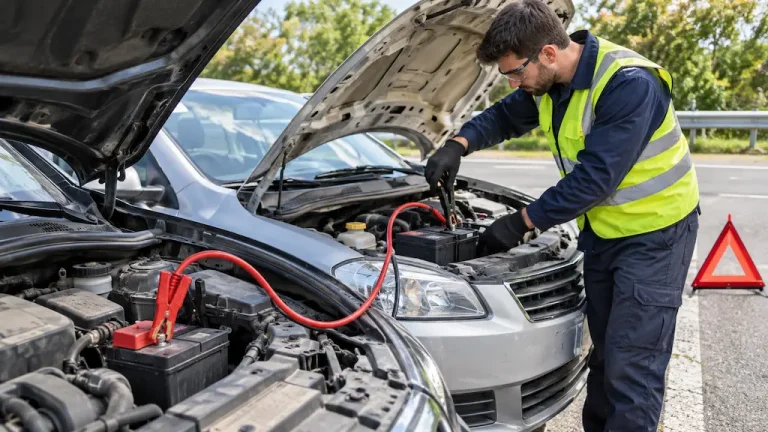
It was 1pm in a Dubai mall car park, 43 degrees outside, and Sara’s SUV would not start. The technician tested the battery and said it had passed. She drove home relieved. The next morning the car was dead again. The test was not wrong. It had answered a different question: the battery could crank an engine, but not how much energy it could still store. That is the whole problem with battery testing.
A load test, a conductance test and a capacity test each measure something different, and each can be right yet useless. Before trusting a result, know what each test measures that is where a jump start service in Dubai starts: with the right test.
Which Test Is Most Reliable? It Depends on the Question
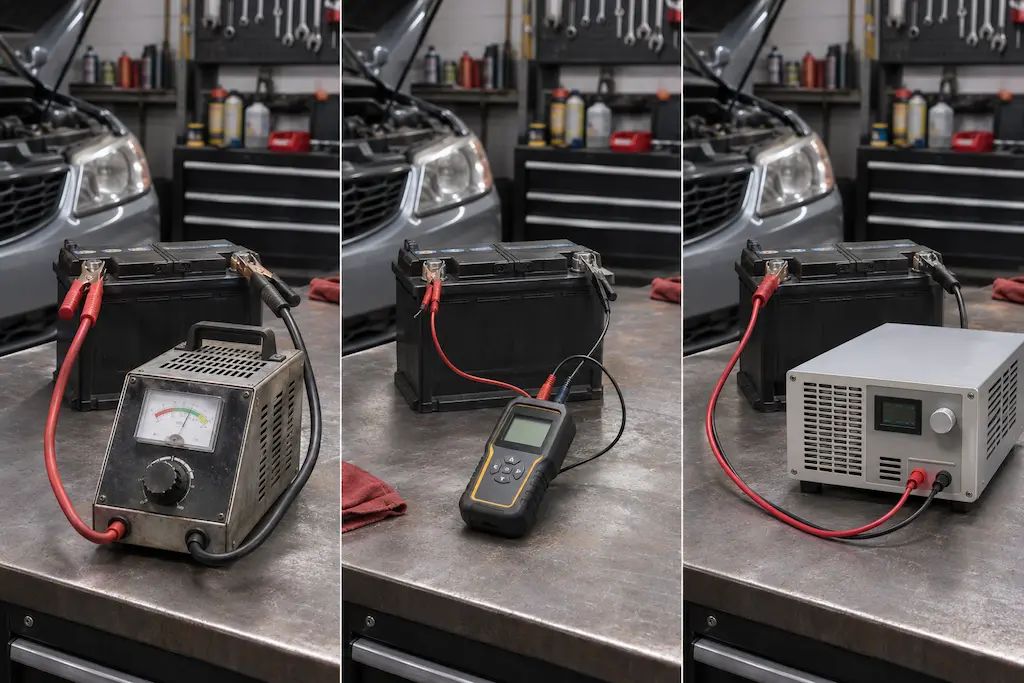
There is no single most reliable battery test, because the three tests do not measure the same thing. A load test answers “can this battery crank the engine right now?” A conductance test answers “is this battery healthy overall?” A capacity test answers “how much energy can this battery still store?” A test can only be reliable for the question it was built to answer. In Dubai, the honest answer usually needs two of them, not one.
What a Load Test Actually Does
A load test is the oldest method. A carbon-pile tester applies a heavy load typically half the battery’s rated CCA for about 15 seconds and watches how far the voltage falls. The reference standard, SAE J537, says a 12V battery must deliver its rated CCA for 30 seconds at -18°C without dropping below 7.2V; at 21°C the pass mark is 9.6V. Because it makes the battery do real work, a load test is a direct measurement the closest thing to actually starting the car. It has one strict condition: the battery must be charged first.
Clore Automotive states a load test needs the battery above 85% state of charge, or a merely flat battery reads as failed. It also generates heat, can finish off a weak battery, is not the right tool for AGM batteries, and is temperature-sensitive.
What a Conductance Test Actually Does
A conductance test works the opposite way: instead of drawing a heavy current, the tester sends a small AC signal through the battery and measures how easily current passes, its conductance, the inverse of internal resistance. As a battery ages, sulfation and corrosion raise internal resistance, so the reading estimates CCA and state of health. The whole test takes 10 to 20 seconds. That is why most workshops use them: no heat, no stress, works on a partly discharged battery, repeatable across temperatures.
The important word is estimate: a conductance tester does not measure cranking power, it infers it from resistance. The Battery Council International puts its correlation with load testing at 95% strong, but not perfect. A sulfated battery can pass and still fail under actual engine load, and a low-energy battery can pass and still leave you stranded.
What a Capacity Test Actually Does
A capacity test asks a different question: how much energy can this battery still hold? It measures stored energy amp-hours, or reserve capacity by discharging the battery under controlled conditions and timing it. That takes hours, which is why you almost never see it done at the roadside. It is the only test that answers the question drivers actually care about when a battery keeps dying: how much life is really left? Battery University is blunt DC load and AC conductance cannot measure capacity. A battery can post a passing CCA number yet have low capacity and collapse under 200-plus amps of starter draw.
The Three Tests Side by Side
| Load test | Conductance test | Capacity test | |
|---|---|---|---|
| What it measures | Voltage under a real load | Internal resistance, then estimated CCA | Stored energy (Ah / reserve capacity) |
| How long it takes | About 15 seconds, plus setup | 10–20 seconds | Hours |
| Main weakness | False fail if flat; stresses weak batteries | Can pass a low-capacity battery | Slow; impractical at the roadside |
| Best for | Confirming cranking power | Quick health screening | Knowing true remaining life |
Which Test Should You Trust for Your Situation?
A routine check on a battery under three years old. A conductance test is enough: fast, safe, repeatable.
Slow cranking, or a battery over three years old. Start with conductance, then confirm a borderline result with a load test. A conductance pass with a load fail usually means sulfation or a weak cell.
The car keeps dying overnight. Neither test fixes this. A battery can test fine and still be drained by something drawing power while parked. If your car battery dies overnight again and again, the drain needs diagnosing separately.
Buying a used car, or a warranty claim. Ask for a load test: the reference standard, and the result a dealer or warranty assessor will accept.
It passed but still dies, or it reads 12.6V but will not start. Voltage is charge, not health: a battery can sit at 12.6V and still be unable to deliver starting current. Capacity is the missing answer ask for a capacity or EIS check.
Why Dubai Heat Changes the Answer
Dubai is hard on batteries: sustained under-bonnet heat accelerates ageing, which is why batteries here commonly fail at two to three years rather than the four or five printed on the label. Chronic undercharging makes it worse: short trips never fully recharge the battery, and sulfation builds up on the plates, permanently reducing capacity.
That matters because sulfation is exactly what a conductance test can miss. On a three-year-old battery, a conductance “pass” is worth confirming with a load test. The charging side matters too: after a jump start, the alternator refills the battery while also running the AC, so how long should you drive after a jump start is a real question here thirty minutes of driving, not idling, is the minimum.
What Happens After the Test
A test result is only useful if it changes what you do next. If the battery is finished, the honest fix is a replacement, fitted on the spot and knowing the car jump start service cost in Dubai before anyone is dispatched means you decide with the price already clear. Quick Jump Start’s service starts from AED 120, confirmed before dispatch, with a battery health check included. If the battery is simply flat, a jump and a proper drive may be all it needs — but only if it can still hold a charge. A jump start gets the engine running; it does not confirm the battery has recovered. How long does a car battery last after a jump start depends on why it went flat, and the overnight test park it, try it in the morning is still the simplest proof.
Frequently Asked Questions
Can a battery pass a conductance test and still be bad?
Yes. Conductance estimates cranking power from internal resistance; it does not measure stored energy. A sulfated or low-capacity battery can pass and still fail under real load.
Is a load test bad for my battery?
On a healthy, charged battery, no. On one already marginal it can finish it off, which is why testers avoid load testing a flat or damaged battery, and why it is not the right tool for AGM batteries.
How long does a capacity test take?
Hours, it is a workshop job, not a roadside one, which is why it is rarely the first test.
My battery reads 12.6V. Is it healthy?
Not necessarily. 12.6V means the battery is charged; it says nothing about its health. Voltage measures charge, not internal condition or remaining capacity.
Which test should I ask for in Dubai?
For a quick check, a conductance test. If the result is borderline, or the battery is over three years old, ask for a load test. If the battery keeps dying despite passing tests, ask about a capacity check.
Conclusion
No single test is the most reliable, because reliability depends on the question. A load test tells the truth about cranking power, but only on a charged battery. A conductance test is the fastest, safest screen, but it estimates rather than measures. A capacity test tells you how much life is left, but it takes hours. For most Dubai drivers: a conductance screen, a load test when the result is borderline, and a capacity check when the car keeps dying.
And when the battery is finished, the fix is not another test it is a replacement, fitted before the next morning’s silence. Quick Jump Start runs a battery health check before every jump start, 24/7 across Dubai, so the test comes before the cables.