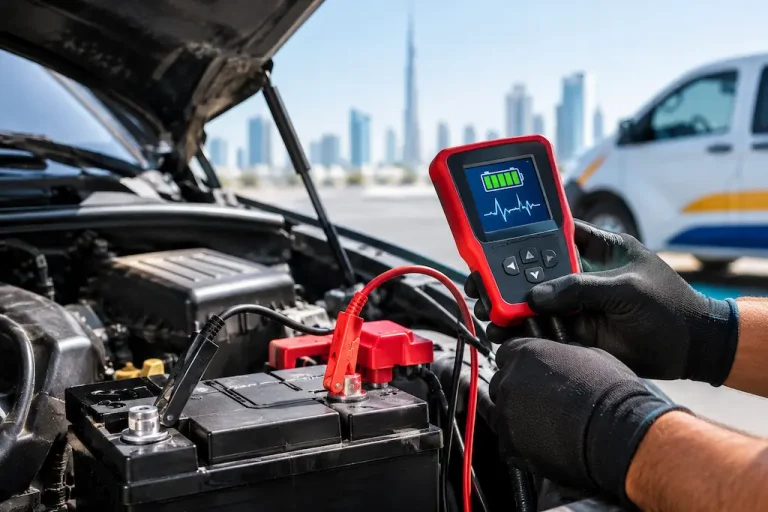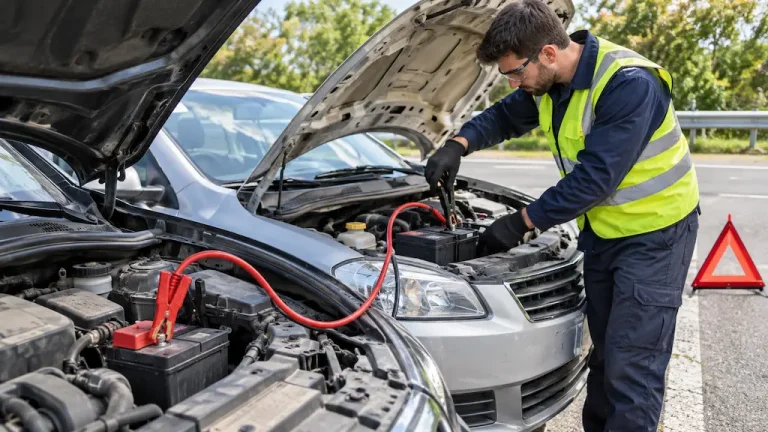
It is 7.40am in a Business Bay car park. Your car has just been jump-started, the engine is running again, and there are twelve minutes of driving between you and the office. You make it. You park, switch off, and go up. The next morning: same car park, same silence when you turn the key.
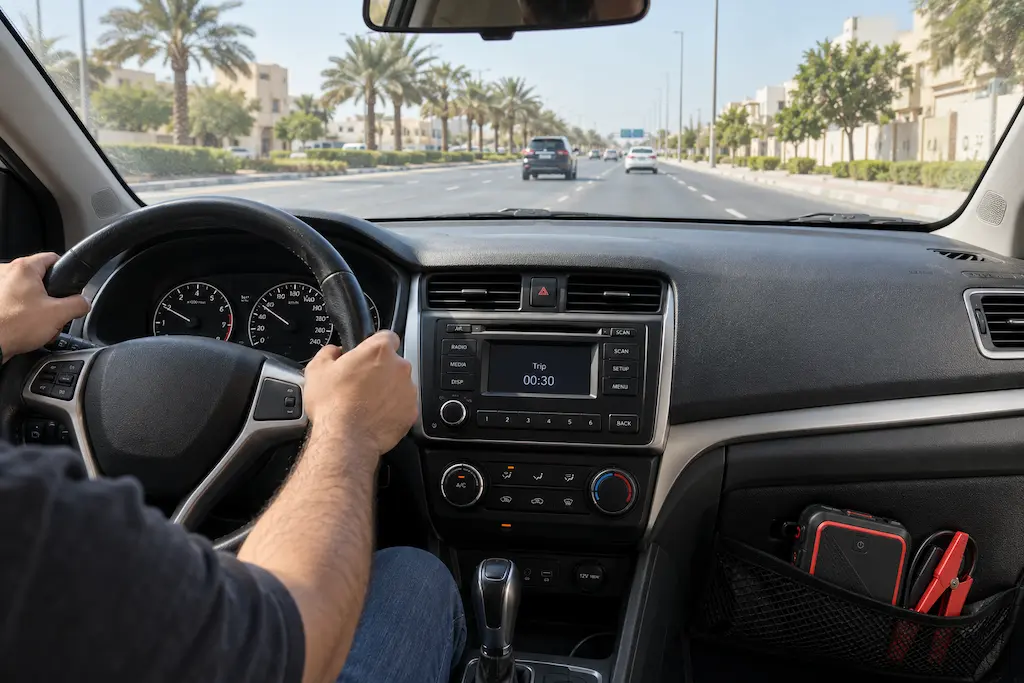
That sequence jumped, driven briefly, dead again is one our technicians see constantly, and the battery is usually not the thing at fault. A jump start borrows enough current to turn the engine over. It puts nothing back. What happens next depends almost entirely on how long you drive before you switch off. Drive for at least 30 minutes, and drive rather than idle. If the battery was deeply flat, make it longer.
Below is where that number comes from, when it is not enough, and what else you can do to help it along, the same advice our technicians give on every jump start in Dubai call-out.
Why You Have to Drive at All
A jump start does not charge your battery. It borrows enough current from another source to turn the starter motor nothing more. The moment your engine fires, responsibility passes to the alternator, and the alternator now has two jobs at once: run everything electrical in the car, and refill a battery that is close to empty.
It was designed for the first job. The second is something it does slowly, as a secondary duty. That is the whole reason the drive has to be long.
Driving Versus Idling: Not the Same Thing
This is the part most drivers get wrong. Leaving the car running in a parking space feels like it should work. It barely does. An alternator is belt-driven, so its output depends on engine speed.
| Idling | Driving at speed | |
|---|---|---|
| Engine speed | ~600–900 rpm | ~2,000–3,000 rpm |
| Alternator output | Roughly 50–70% of rated | Roughly 80–100% of rated |
| Charge going to the battery | What little is left after running the car’s electrics | Significantly more |
| 30 minutes of it | Marginal | Meaningful |
At idle, a large share of what the alternator produces is consumed by the car itself, ignition, fuel pump, lights, fans, infotainment. In a Dubai summer, with the AC compressor running, there may be very little left over for the battery.
Thirty minutes of idling is not thirty minutes of charging, If you only have half an hour, spend it moving.
How Long You Actually Need
It depends how flat the battery was before the jump.
| Situation | Minimum drive | Notes |
|---|---|---|
| Mild drain – interior light left on for a few hours | 30 minutes | Steady driving should restore a working charge |
| Overnight drain – headlights left on all night | 45–60 minutes | Longer is better; avoid stop-start traffic |
| Deep discharge – car flat for days, no clicking at all | 1–2 hours or more | A mains charger is the better tool here |
| Battery over 3 years old | Drive 30+ minutes anyway | The drive will help, but age may be the real problem |
These are minimums for getting back to a usable charge, not for filling the battery completely. A fully flat lead-acid battery takes far longer than one drive to reach 100%, which is why a car that has been jumped benefits from a few longer journeys over the following week rather than a return to short trips.
Why 30 Minutes Is Often Not Enough in Dubai
The standard advice assumes an open road and a mild climate. Neither applies here.
The AC is drawing hard: The compressor, blower and condenser fans all run off the same alternator that is meant to be refilling your battery. On a 45 °C afternoon, that is a substantial share of the output going somewhere other than the battery.
Traffic keeps engine speed low: Thirty minutes crawling along Sheikh Zayed Road at six in the evening is mostly spent near idle. Thirty minutes on an open road at a steady 100 km/h is a completely different charge.
Practical version: if you have just been jumped at 5pm on a weekday, a loop out toward a clearer road will do more for the battery than the same half hour spent in the queue home.
What to Switch Off While You Drive
Everything electrical you switch off leaves more of the alternator’s output for the battery. Within reason:
- Air conditioning – the biggest single load. If the cabin is bearable, ease it back for part of the drive
- Headlights – if it is daylight and your car allows it
- Heated seats and heated mirrors – rarely needed here
- Phone charging and accessories – small individually, worth it together
- Audio at high volume – a modest but real draw
Do not compromise safety for charging. Headlights at night, hazards when needed and enough AC to stay alert all come first. This is about trimming the optional loads, not driving uncomfortably or unsafely.
Can You Use a Battery Charger Instead?
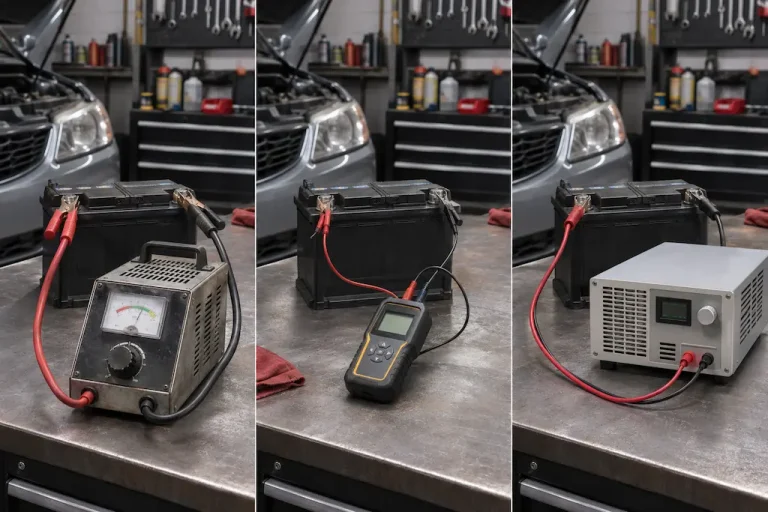
For a deeply discharged battery, yes, and it is usually the better option. A mains charger delivers a controlled charge at a steady rate for as long as you leave it connected. It does not have to run the car at the same time, and it does not depend on your engine speed or your schedule.
An alternator is a maintenance device. A charger is a filling device. If your battery has been flat for days, the charger will do a better and gentler job than several hours of driving.
The catch is time and access: you need somewhere to park near power, and several hours. For most drivers who have just been rescued at the roadside, driving is the practical choice and a charger is worth considering afterwards.
What Not to Do After a Jump Start
Do not switch the engine off to run an errand:
Twenty minutes of driving followed by ten minutes in a shop, then an attempt to restart, is the most common way people end up needing a second jump.
Do not rely on short trips afterwards:
A week of five-minute school runs will not recharge a battery that started the week half empty. It will quietly drain it further.
Do not assume it is fixed:
A jump start plus a drive is a recovery, not a repair. If the battery is old or something is draining it, the problem is still there.
Do not jump it again repeatedly:
Each deep discharge permanently reduces a lead-acid battery’s capacity. A car needing regular jumps is telling you something.
How to Tell Whether It Worked
Park the car overnight and try it in the morning.
- Starts normally – the charge held. Likely a one-off drain
- Starts slowly or needs a second try – not holding properly; get it tested
- Does not start – either the battery cannot hold charge or something is draining it overnight, both covered in our guide to why your car battery dies overnight
Frequently Asked Questions
Is 30 Minutes of Idling Enough?
No. At idle an alternator produces roughly 50–70% of its rated output, and much of that runs the car itself. Driving is substantially more effective.
Can I Just Drive Normally the Next Day Instead?
Only if the battery holds enough charge to restart the car, which is the risk. Drive now, while the engine is already running.
Does Driving Faster Charge It Faster?
Up to a point higher engine speed means higher alternator output. But steady driving at normal speeds is enough; there is no benefit in driving unsafely.
Will One Long Drive Fully Recharge a Flat Battery?
Usually not completely. It should restore enough to start reliably, but a deeply discharged battery may need several longer drives or a mains charger to reach full capacity.
My Battery Is Four Years Old. Will the Drive Help?
It will help, but age is probably the underlying issue. UAE heat shortens battery life considerably, as we explain in why Dubai’s heat kills car batteries. Have it tested rather than relying on the drive.
Should I Turn the AC Off Completely?
Not if it makes driving unpleasant or unsafe in UAE heat. Ease it back where you comfortably can, it is a useful lever, not a rule.
What If I Cannot Drive for 30 Minutes Right Now?
Drive as long as you can, then plan a longer trip soon, and be prepared for the car not to start next time. If that is not a risk you can take, have the battery tested before you park it.