It’s 7:40 am in a Dubai Hills basement, the school run starts in twenty minutes, and your Cayenne answers the key with a click and a dim dashboard. You open the bonnet expecting to find the battery, but it isn’t there. This is when many owners discover that a Cayenne does not jump-start like an ordinary car. Porsche places the 12V battery away from the engine bay and provides dedicated jump points instead.
Clamping onto the wrong spot can interfere with the control modules that manage the gearbox, air suspension, and stability systems. If you are unsure about the correct connection points, using a quick jump start service in Dubai can help get the vehicle started safely without risking sensitive electronics. This guide explains how to jump-start a Porsche Cayenne step by step and what to check once it is running.
Why a Cayenne Isn’t Like Other Cars
Even a Cayenne E-Hybrid wakes up on a conventional 12V battery, so jump-starting a hybrid Cayenne follows the same terminal rules. The main difference is that you need to stay well clear of the orange high-voltage cables.
After It Starts: What to Check:
If the car is flat again the next morning, you need to work out whether you’re dealing with a dead battery or a failing alternator before paying for parts you may not need.
On most Cayennes, the battery isn’t under the bonnet. First-generation models (2003–2010) usually keep it under the driver’s seat. Later generations vary by model year and powertrain, so check your owner’s manual for your car.
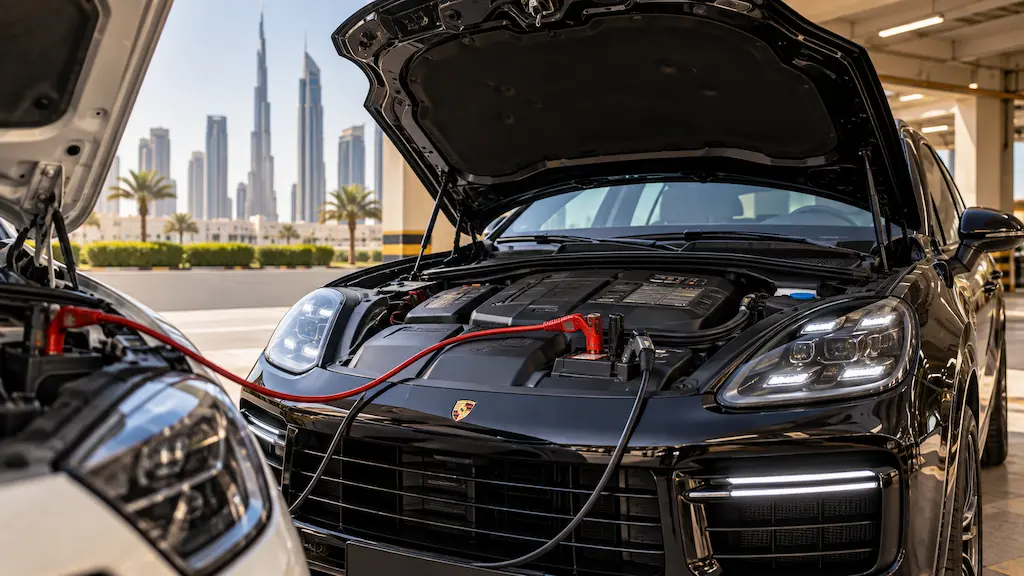
The battery is hard to reach, so Porsche runs power to jump terminals in the engine bay. These are the only points you should use.
| Connection point | Where to find it | What it does |
|---|---|---|
| Positive jump post | Engine bay, under a plastic access cover, beneath a red cap | Routes power to the hidden battery |
| Ground point | A bare metal post or bar close to the positive post | Completes the circuit away from the battery |
| The battery itself | Under a seat or cargo floor, depending on year | Leave it alone during a jump |
Never connect a clamp directly to a battery that sits inside the cabin. A weak battery can release hydrogen gas, and a spark at the terminal would be right next to the seats.
Even a Cayenne E-Hybrid wakes up on a conventional 12V battery, so jump-starting a hybrid Cayenne follows the same terminal rules. The main difference is that you need to stay well clear of the orange high-voltage cables.
Before You Start: Safety Checklist
Take two minutes to check these before any cable comes out:
- Matching voltage. The donor car must have a 12V system. Never jump from a truck or bus running 24V.
- Cable condition. Use heavy-gauge cables with tight clamps and no cracked insulation. Thin, cheap cables overheat under a Cayenne’s starting load.
- Everything off. Switch off the ignition in both cars, plus the AC, headlights and seat heaters. Keep the key away from the start button so nothing wakes up mid-connection.
- Warning signs. If you smell rotten eggs, see a swollen battery case, or find fluid under the seat, stop. That battery needs replacing, not jumping.
- Heat. In a Dubai summer, engine-bay parts can be hot enough to burn skin. Wear gloves and let the engine cool if the car was just driven.
Step-by-Step: Jump-Starting Your Cayenne
1. Position the donor car:
Park it close enough for the cables to reach, but don’t let the two cars touch. Put both in Park with the handbrake on. In tight basement bays in JLT or Business Bay, a portable booster pack is often easier than lining up two SUVs.
2. Open the jump terminals:
Remove the plastic access panel in the engine bay (which side it’s on depends on the generation). Flip up the red cap to expose the positive post, and find the ground post next to it.
3. Connect red to the Cayenne
Attach one red clamp firmly to the Cayenne’s positive jump post.
4. Connect red to the donor:
Attach the other red clamp to the donor battery’s positive (+) terminal.
5. Connect black to the donor:
Attach one black clamp to the donor battery’s negative (–) terminal.
6. Connect black to the Cayenne’s ground point:
Attach the last clamp to the Cayenne’s designated ground post, not the battery and not a painted surface. Keep the cables clear of belts and the cooling fan.
7. Start the donor, then the Cayenne:
Let the donor idle for 2–3 minutes to push some charge through. Then start the Cayenne. Crank for no more than 10 seconds at a time and wait a minute between attempts. If it still won’t start after two or three tries, stop. More cranking risks the starter and won’t bring back a battery that’s failed.
8. Disconnect in reverse order:
Remove black from the Cayenne, then black from the donor, then red from the donor, then red from the Cayenne. Close the red cap and refit the access panel.
After It Starts: What to Check
Getting the engine running is only half the job. Here’s what to do next:
- Drive, don’t idle: Aim for 20–30 minutes of steady driving. Crawling along Sheikh Zayed Road at rush hour won’t give the alternator enough time to recharge the battery.
- Expect some warning lights: Low voltage can trigger chassis, PSM or suspension messages. These often clear after a drive cycle. If they stay on, have the fault codes read.
- Check the voltage if you can: A healthy, fully charged battery reads about 12.6V at rest. A reading of 12V or below means it needs charging or replacing.
- Plan for the replacement: Many later Cayennes use AGM batteries, and a new battery usually has to be registered with a diagnostic tool so the charging system manages it correctly.
If the car is flat again the next morning, you need to work out whether you’re dealing with a dead battery or a failing alternator before paying for parts you may not need.
When to Skip DIY and Call for Help
A DIY jump makes sense when you have a donor car, the right cables and space to work. It’s the wrong call when:
- The battery looks swollen, smells, or is leaking.
- The car clicks but won’t crank even with a good connection.
- You’re parked on a hard shoulder or in a crowded basement with no room for a second car.
- You own an E-Hybrid and aren’t sure which terminals are safe to touch.
- It’s a 45°C afternoon and the battery has already been jumped once this week.
Dubai’s heat is especially hard on batteries. Many don’t last much beyond two years here, so one flat battery is often a warning that a replacement is due.
Quick Jump Start sends technicians trained on start-stop and hybrid electrical systems to your Cayenne, 24/7. We reach most areas of Dubai in 15–30 minutes, with prices from AED 120 confirmed before we set off. Every visit starts with a battery health check, and if the battery can’t hold a charge, we can replace it on the spot so you don’t need a second visit
Conclusion
Jump-starting a Porsche Cayenne isn’t difficult, but it rewards doing it the Porsche way. Use the engine-bay jump terminals, never the hidden battery. Connect in the right order, keep cranking short, and let the car recharge properly on a real drive rather than idling in traffic. Just as important is reading what the jump tells you. If a Cayenne needs a boost more than once, especially after a Dubai summer, the battery is telling you it’s near the end. Deal with it on your own schedule, not in a basement at 7:40 am.
If you’d rather not handle cables yourself, or the jump doesn’t hold, Quick Jump Start can reach your Cayenne anywhere in Dubai, day or night.
Frequently Asked Questions
Where are the jump-start points on a Porsche Cayenne?
In the engine bay, under a plastic access cover. The positive post sits beneath a red cap, and a bare metal ground post is close by. Use these instead of the battery, which is usually under a seat or the cargo floor, depending on the model year.
Can I jump-start my Cayenne from a regular car?
Yes, as long as the donor car has a healthy 12V battery. A small hatchback can do it, but give it a few minutes of idling before you try to start the Cayenne, since the SUV draws a heavy load when cranking.
Can jump-starting damage my Cayenne’s electronics?
It can if the clamps go on in the wrong order, touch each other, or connect to the wrong points. Following the correct sequence and using the designated terminals keeps the risk low. Some warning lights after a jump are normal and usually clear after a drive.
Is a portable jump starter safe for a Porsche Cayenne?
Yes, provided it’s rated for large petrol or diesel engines and connects to the same engine-bay terminals. In tight Dubai parking bays, a booster pack is often safer and quicker than bringing in a second car.
How long should I drive after jump-starting my Cayenne?
Aim for at least 20–30 minutes of steady driving. Short trips and stop-start traffic won’t put back enough charge, and the car may fail to start again the next morning.