It is 6:50 am in a Dubai Marina basement car park. Your car answers the key with a single click, and a neighbour pulls up alongside with cables in his boot. He clips the leads on and leaves his engine idling. Someone else walking past says to switch it off. Both of them sound certain, and you are now standing between two cars with no idea which one is right.
They are both partly right, which is why the question keeps coming up. The donor car should be running for one part of the procedure and switched off for another, and getting that order wrong is one of the few ways a routine jump start in Dubai turns into an electrical repair bill. Here is what actually happens in each phase, and what to do in each one.
Quick Answer: Yes, the donor car should be running at the moment you crank the dead car. But it should be switched off before you remove a single clamp.
That second half is the part almost nobody mentions, and it is the half that protects both vehicles. A jump start is not one electrical event. It is three, and the correct state of the donor engine changes between them.
| Phase | Donor engine | Why |
|---|---|---|
| Attaching the four clamps | Off | No alternator output, so no voltage transient when a connection is made |
| Cranking the dead car | Running | Supplies the current the starter needs and protects the donor’s own battery |
| Removing the clamps | Off | Breaking the circuit while the alternator is charging is the one step that can destroy electronics |
If you remember nothing else: connect with it off, crank with it on, switch it off again before you disconnect.
Why the donor should be running while you crank
A starter motor on a modern engine draws an enormous amount of current for a few seconds. The dead battery cannot supply it, so that current has to come from across the cables.
With the donor engine off, the only source is the donor battery. It will often cope with a small petrol engine, but it is being deeply discharged to do so, and you now have two flat batteries instead of one.
With the donor engine running, its alternator is producing roughly 13.5 to 14.5 volts and carrying most of the load. That does three useful things:
- It holds system voltage up while the starter drags it down, so the dead car’s engine management has enough voltage to fire.
- It puts a small surface charge into the flat battery while you wait, which often makes the difference on the second attempt.
- It stops the donor’s own battery being drained to the point where the donor needs a jump too.
This is not just field practice. It is what manufacturers write down. Honda’s owner’s manual instruction for jump starting is to start the assisting vehicle’s engine and raise its rpm slightly before attempting to start your own.
How long should you let it run first?
Two to three minutes of idling is enough for most flat batteries. If the car has been sitting for several days, or the battery is deeply discharged, five minutes is more realistic. Raising the donor’s engine speed to a fast idle around 1,500 rpm increases alternator output and shortens the wait.
After that, crank in short attempts. Twenty seconds maximum, then wait two full minutes before trying again. Continuous cranking overheats the starter motor and does nothing a short attempt did not already do.
Why it must be switched off before you disconnect
This is the step that separates a safe jump start from an expensive one, and it is almost entirely absent from the pages ranking for this question.
When you pull a clamp off while an alternator is actively charging, the alternator suddenly loses its load. Its output voltage spikes before the regulator can respond. The automotive industry has a name for this a load dump and it is severe enough to have its own test in the international standard for automotive electrical equipment.
The load dump pulse simulates exactly this: a battery disconnected while the alternator is supplying charging current. In a 12-volt system the suppressed pulse is clamped at around 35 volts, while an unsuppressed pulse can peak somewhere between 79 and 101 volts. Components that are not protected against it can be permanently damaged by a single event.
Your car’s modules are designed with that pulse in mind. They are not designed to be handed one casually in a car park, with a flat battery on the other end of the cables doing nothing to absorb it.
This is why manufacturer procedures are explicit about the order. Jaguar Land Rover’s technical bulletin on jump starting discharged batteries, filed with NHTSA, runs: start the donor and let it idle, start the disabled vehicle, switch off the donor vehicle, and only then begin removing the leads, negative from the recovered car, negative from the donor, then the positives.
The rule in one line: no clamp comes off while either alternator is spinning.
Why you should connect with the donor switched off too
The same physics applies in reverse at the start. Making the final connection while an alternator is running introduces the voltage difference between a charged system and a flat battery across a live charging circuit.
Connecting with the donor engine off lets the two batteries begin equalising gently before any alternator is involved. You then start the donor once all four clamps are secure. It costs nothing, and it removes a transient from the procedure entirely.
This is also why the final black clamp goes on bare metal on the dead car’s engine block rather than on the battery’s negative post. Any spark occurs away from the hydrogen that a charging lead-acid battery vents, and the ground reference sits away from the battery itself.
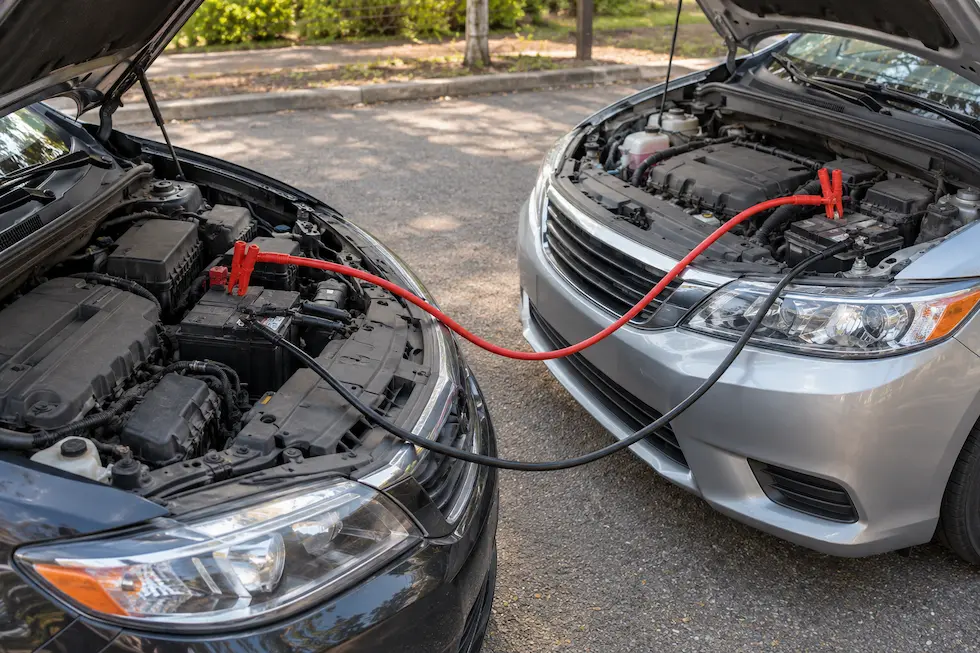
The full sequence, in order
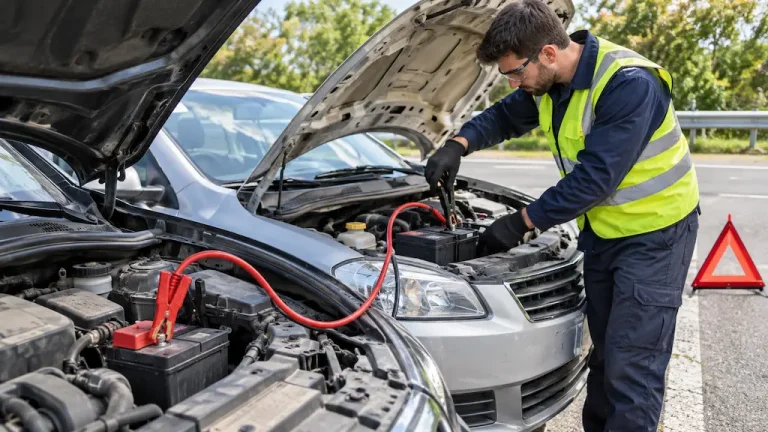
- Park and switch everything off, Both cars off, handbrakes on, both in Park or neutral. Turn off lights, air conditioning and the radio in both vehicles. The cars must not touch each other.
- Red to the flat battery’s positive terminal.
- Red to the donor battery’s positive terminal.
- Black to the donor battery’s negative terminal.
- Black to bare, unpainted metal on the dead car’s engine block, not to its battery.
- Start the donor car, Let it idle, or hold a fast idle, for two to three minutes.
- Crank the dead car, Twenty seconds maximum. If it does not start, wait two minutes and try once more.
- Once it is running, switch off the donor car.
- Remove the clamps in exact reverse order, engine-block ground, donor negative, donor positive, recovered car positive.
- Drive for at least 20 to 30 minutes, A jump start is not a charge. The alternator needs sustained running to put the charge back.
If you want this with model-specific terminal locations, our guide to jump starting a Porsche Cayenne safely walks through a car where the battery is nowhere near where most drivers expect it.
Does a jump start damage the donor car’s alternator?
Rarely, if the sequence above is followed. Supplying current to another vehicle for a few seconds is within what an alternator handles routinely.
The risk rises in specific situations, and these are worth knowing before you agree to help a stranger in a car park:
- A small donor and a large recipient: A 1.6-litre saloon jumping a V8 SUV asks the small alternator to carry a load it was never sized for. Give it longer at fast idle rather than cranking repeatedly.
- A recipient with a deeply discharged or shorted battery: A battery that will not accept charge turns the donor’s alternator into the sole supply for a hopeless cause.
- A recipient with a failed alternator: The car will start and then stall once the borrowed charge runs out. If you are unsure which fault you have, our guide to telling a dead battery or failing alternator apart separates them in a few minutes.
- Disconnecting under load: Covered above, and the only one on this list that causes sudden, permanent damage.
Frequently asked questions
Should both cars be running at the same time?
Briefly, yes the moment the recovered car fires, both engines are running. Leave them connected for a minute or two if you like, but switch the donor off before you start removing clamps.
Can I jump start a car without the donor engine running at all?
Often, yes, if the donor battery is healthy and the recipient engine is small. It is slower and it discharges the donor battery more deeply. On a large engine, or a battery that has been flat for days, you will usually need the alternator’s help.
Should I rev the donor car’s engine?
A fast idle of around 1,500 rpm while charging is useful and is what several manufacturer procedures suggest. Do not rev it hard at the moment of cranking, and never rev it while a clamp is being attached or removed.
How long should I leave the cars connected after it starts?
A minute or two is plenty. The recovered car’s own alternator takes over immediately. What matters more is the drive afterwards 20 to 30 minutes of running to actually replace the charge.
Is a portable jump pack safer than a donor car?
For modern vehicles, generally yes. A quality lithium jump pack delivers regulated voltage, includes reverse-polarity and surge protection, and involves no second alternator at all, so the load dump risk disappears. It also works in a basement bay where no donor car can reach you.
Can jump starting damage my car’s computer?
The main risks are reversed polarity, which can destroy modules in seconds, and disconnecting while an alternator is charging. Follow the clamp order, and switch the donor off before disconnecting, and both are avoided.
My car started on the jump but died again an hour later. What now?
That is the classic signature of a charging fault rather than a flat battery. Jumping it again will produce the same result. It needs the alternator and battery tested.
Conclusion
The donor car should be running when you turn the key, and switched off before you touch a clamp. Connect cold, crank hot, disconnect cold. Everything else in a jump start is just getting the four clamps in the right order.
If the battery is cooked, or you are in a basement bay with no room for a second car, the jump itself stops being the answer. Quick Jump Start reaches most of Dubai within 15 to 30 minutes, 24 hours a day, with technicians equipped for start-stop, AGM and hybrid systems and if the battery will not hold a charge, it can be replaced where you are, rather than booking a second visit.