You are standing over an open bonnet with a jumper cable in your hand, and a thought arrives that was not there a second ago: is this actually safe?
It is a fair question. Car batteries can explode, and the moment you are standing in is one of the two most common times it happens. The reassuring part is that it is almost entirely preventable, and the prevention comes down to a few things you can do in the next two minutes.
This guide explains what actually causes a battery to explode, which batteries should never be jumped at all, and how to connect cables so the risk largely disappears. It is the safety side of every jump start in Dubai our technicians carry out.
If a battery is swollen, cracked, leaking, or smells of rotten eggs do not jump start it, do not charge it, and do not lean over it. Skip to the warning signs section below.
Quick Answer: Yes. A lead-acid car battery can explode, and when it does it is violent, the case bursts, throwing plastic fragments and sulfuric acid outward at face height.
It is not common, but it is not freakish either. American emergency-room data collected for the National Highway Traffic Safety Administration found that charging a battery accounted for about 31% of battery-explosion injuries, and jump starting about 19%. Between them, those two activities caused roughly half.
The injuries skew toward the eyes, because that is where your face is when you lean over the battery. Prevent Blindness America estimated that nearly 6,000 people a year suffered serious battery-related eye injuries.
What Actually Causes It
A lead-acid battery is a chemical system that produces gas as a by-product.
When a battery is charged by your alternator, by a charger, or by jumper cables from another car some of the water in the electrolyte splits into hydrogen and oxygen. Both escape through the battery’s vents.
Hydrogen is extremely flammable. It ignites at concentrations as low as about 4% by volume in air, and it takes very little energy to set off: a small spark is more than enough.
If hydrogen has collected around or inside a battery and something sparks, it ignites almost instantaneously. The battery case is not built as a pressure vessel, so the pressure escapes the only way it can by bursting the case. What comes out is sharp plastic and sulfuric acid.
Sulfuric acid is corrosive. It causes permanent damage to eyes, potentially including blindness, and painful burns to skin.
The Four Situations Where It Happens
1. Connecting or disconnecting jumper cables:
Clamping onto a battery terminal makes a spark. If that spark happens directly above a battery that has been venting hydrogen, it has an ignition source and fuel in the same place. This is why clamp order matters so much more below.
2. Charging:
The highest-risk activity in the injury data. Charging produces hydrogen continuously, and in an enclosed space a closed garage, a store room, it can accumulate. Charging at too high a voltage, generally above about 14.4 V on a 12-volt system, drives hydrogen production harder.
3. Overcharging from a vehicle fault:
A failing voltage regulator or alternator can push the charging voltage too high, gassing the battery continuously while you drive. If you are not sure whether your problem is the battery or the charging system, our guide to telling a dead battery or failing alternator apart explains how to separate them.
4. An internal fault:
A battery with a shorted cell, or with electrolyte so low that the lead plates are exposed, can spark inside the case, where the hydrogen concentration is highest. Nothing external has to go wrong at all. This is the scenario where a battery explodes seemingly without warning and it is the one Dubai’s climate makes more likely.
Why The Last Clamp Goes On the Engine Block, Not the Battery
If you take one practical thing from this article, take this. The correct jump start sequence ends with the final black clamp attached to bare, unpainted metal on the engine block of the dead car not to the battery’s negative terminal.
The reason is precisely the explosion risk. Completing the circuit makes a spark. Attaching that last clamp to the engine block puts the spark half a metre away from the battery vents, rather than directly over them.
It is a small change in where you clip a cable, and it is the difference between a spark in clean air and a spark in a cloud of hydrogen.
The same logic applies in reverse when you finish: the engine-block clamp comes off first. Our guide on whether the donor car should stay running during a jump start covers the full connect-and-disconnect sequence, including why the donor engine should be switched off before any clamp is removed.
Batteries That Should Never Be Jumped At All
Check these before you touch a cable. Each takes seconds.
| What you see or smell | What it means | What to do |
|---|---|---|
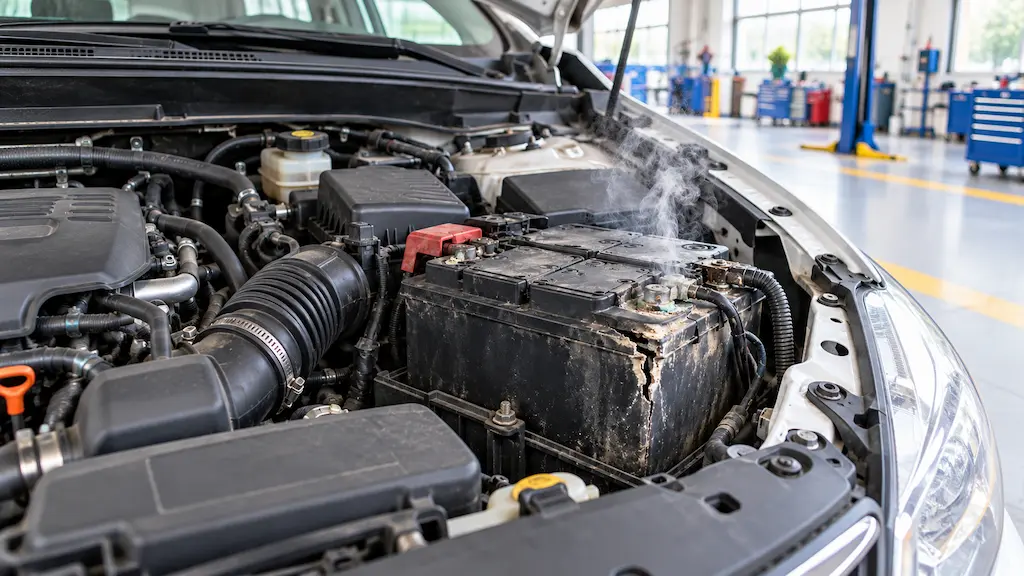
| Swollen or bulging case | Internal pressure or heat damage | Do not jump, do not charge. Replace it |
| Cracks or visible leaks | Case integrity already gone | Do not touch without gloves and eye protection |
| Rotten egg or sulphur smell | Possible hydrogen sulfide from overcharging | Move away, ventilate, do not create any spark |
| Heavy corrosion on the terminals | Poor connection, arcing risk | Have it cleaned and inspected before jumping |
| Visibly low or empty electrolyte | Plates may be exposed, internal spark risk | Do not jump or charge |
| Case hot to the touch | Active internal fault | Move away and call for help |
A swollen battery in particular is a replacement job, not a jump start job. Pushing current into it is exactly the wrong response.
What Dubai’s Heat Does To The Risk
The UAE climate makes one of these failure modes more likely.
Heat accelerates the loss of water from the electrolyte. Over a Dubai summer, a battery that is not sealed can lose enough fluid to leave the top of the lead plates exposed. Exposed plates are where internal sparking becomes possible and it is happening inside the case, surrounded by hydrogen.
The same heat shortens battery life generally, which is why batteries here often fail at two to three years rather than four or five. We covered the chemistry in why Dubai’s heat kills car batteries.
The practical consequence: an old battery that has been through several UAE summers deserves more caution than its age alone suggests.
How to Jump Start Without Creating The Risk
- Look at the battery first, Run through the table above before anything else.
- No flames, no cigarettes, no sparks, Hydrogen needs very little to ignite.
- Wear eye protection if you have it, Sunglasses are better than nothing.
- Both engines off while connecting.
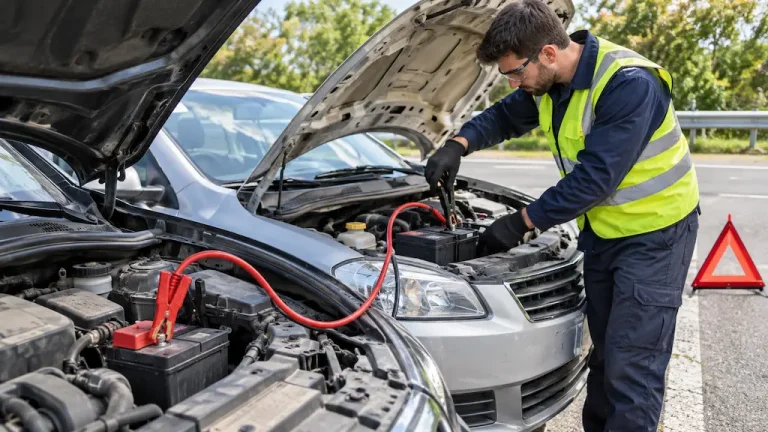
- Red to the flat battery’s positive, red to the donor’s positive, black to the donor’s negative.
- Black last, to bare metal on the dead car’s engine block, Never the battery post.
- Do not lean over either battery while making the final connection or while cranking.
- Disconnect in reverse, engine-block clamp first, with the donor car switched off.
A quality portable jump pack removes most of this risk, because it has no second battery venting hydrogen and includes spark and reverse-polarity protection. It is a genuinely safer tool than cables for most drivers.
If a Battery Does Explode
- Acid in the eyes is a medical emergency: Flush with clean water continuously for at least 15 minutes, keeping the eyelid open, and get medical help immediately. Do not stop early because it feels better.
- Acid on skin or clothing: remove contaminated clothing and flush the area with plenty of water.
- Fragments: do not rub your eyes or face, and do not pick at embedded pieces.
Then call for help In the UAE, ambulance is 998 and police 999. Afterwards, the battery and the surrounding area need proper cleanup acid damages paint, wiring and the battery tray and the charging system should be checked, because overcharging may have caused it.
Frequently Asked Questions
How often do car batteries actually explode?
Rarely, relative to how many jump starts happen daily. But the injury data shows charging and jump starting together account for about half of battery-explosion injuries, which is why the handling procedure matters.
Can a battery explode while just sitting there?
It is far less likely, but a battery with a shorted cell or very low electrolyte can fail without being charged. Swelling or heat in a parked car is a warning sign.
Can a battery explode while I am driving?
Uncommon, but possible if the charging system is overcharging it. A burning or rotten-egg smell from the engine bay while driving should be checked promptly.
Are AGM and sealed batteries safe from this?
Safer, not immune. A sealed AGM battery does not normally vent gas, but it can if it is overcharged, and the pressure has nowhere easy to go.
Is a jump starter pack safer than cables?
Generally yes. There is no second battery producing hydrogen, and quality packs include protection against sparks and reversed polarity.
My battery smells like rotten eggs. What does that mean?
It can indicate hydrogen sulfide produced by overcharging. Treat it as a stop signal: do not create a spark, ventilate the area, and have the battery and charging system checked.
When the safe answer is not to do it yourself
Most jump starts are routine. But if the battery is swollen, leaking, smells wrong, or you are not confident about clamp order in a tight underground car park, the right call is to let someone else handle it.
Quick Jump Start reaches most of Dubai in 15 to 30 minutes, 24 hours a day, with technicians equipped for start-stop, AGM and hybrid systems and if the battery is beyond a jump, it can be replaced where you are.